
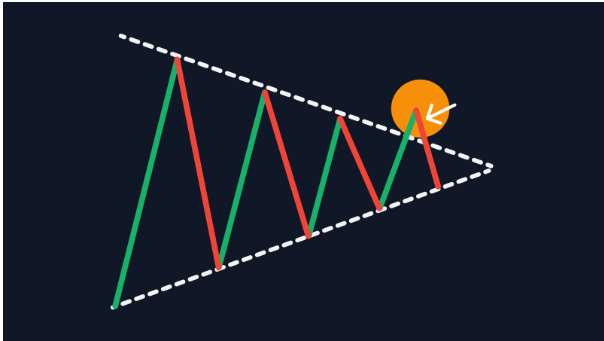
Traders usually flock to opportunities offered by illiquid stocks to fling mischief about and earn quick gains. Price manipulation may easily occur due to their low trading volumes. A price breakout in such stocks may look attractive on a price chart but prove quite false. At this juncture, tick trading would help to ascertain if the breakout was truly genuine or just an imposter.
Understanding Tick Trading
Tick trading can be defined as the study of the smallest possible price movement in a stock: one “tick” is an individual trade. Thus, rather than solely depending on the data obtained from cumulative trade sessions like moving averages or candlestick charts, tick traders diligently monitor every sale made in the stock. Instead, homage is paid to the timing, magnitude, and frequency of those immediate buy or sell orders, giving the trader a micro-view of market happenings.
Illiquid Stocks: Why Are They Any Different?
Illiquid stocks usually trade under low daily volumes and are often characterized by a much wider bid-ask spread. Since there is a low activity level in such stocks, very small orders could create quite a change in the price level. This could therefore mean a pure breakout with no justification from the cause.
Some of the characteristics of illiquid stocks are as follows:
– Low daily traded volume—prices become sensitive to a single big order.
– Wide bid-ask spreads -a disadvantage in terms of cost in entering and exiting trades.
– Price gaps—when no imminent market activity is there.
These factors make illiquid stocks riskier and prone to false signals for breakout. Just in such conditions, tick trading can help drown the noise.
Theoretical Background on Fake Breakouts
Breakouts technically result when prices either break out above resistance levels or below support levels and are usually seen as initiatory signals of price trends. In liquid stocks, breakouts supported by good volume usually denote legitimate interest of market players. However, in illiquid stocks, these breakout levels may be breached by a huge trade but not be sustained.
How Tick Trading Identifies Fake Breakouts
Tick trading gives the opportunity to analyze market activities at the utmost level of detail. Here is how tick trading signals fake breakouts in the illiquid stocks:
1. Watching trade size and frequency
When an illiquid stock truly breaks out, it should draw mounting buying interest in the form of many smaller trades and one-off larger trades. On the contrary, if the activity is driven by one or two larger trades with subsequent inactivity, it is likely to be a false breakout. Immediately, tick charts can easily reveal such irregularities.
2. Observing spread behavior
A real breakout generally sees bids rising steadily, as buyers compete to secure shares, while if the breakout occurs without improvement in bid prices, with most activity at the ask, it may be artificial. Tick trading allows for the instant observation of these variable changes.
3. Seeing through order book manipulations
Occasionally, some market participants will place huge orders to mislead the market and cancel such orders before execution. While this is not reflected on the standard charts, tick data would instead suggest that there were no trades executed at these price levels, thus indicating a potential fake breakout.
4. Identifying Poor Follow-Through
On a real breakout, subsequent ticks should confirm continued momentum, with trades being done at progressively higher prices. A tick-by-tick analysis can quickly show whether prices stall or reverse just shortly after the breakout.
How Ticks Can Be Used in Trading Illiquid Stocks
In tick trading of illiquid stocks, trader strategies could adopt the following:
a) Overlay Tick Chart Analysis with Volume Analysis
Watching ticks alongside the actual volume at which trades are executed is a mechanism to ascertain that price moves are supported by market interest. Inversely, when rapid ticks are not accompanied by considerable volume, algorithmic activity or short-term manipulation becomes evident.
b) Focus on Execution Speed
Real momentum is supposed to be validated by a breakout through fast successive trades. Any long, silent spell between two trades during a breakout indicates weak conviction.
c) Set Strict Risk Control Limits
Illiquid stocks might reverse sharply, so one must have strict stop losses defined when applying the tick data. In this way, smaller fake breakouts won’t become larger losses.
d) Use Multiple Timeframes
Tick charts give rise to immediate insights, while pairing that with something like short-term and daily charts goes further to confirm signals and thus prevent overreacting.
Limitations of Tick Trading in Illiquid Markets
While tick trading is a great tool nonetheless, sometimes its utility may be cast into doubt. Illiquid stock can deceive even on tick data. As a concept, low liquidity equals low data point numbers, which means ticks may be manipulated temporarily. Also, the greater work on tick trading is in constant monitoring.
To alleviate these limitations, traders often take the additional step of combining tick analysis with other market indicators, including depth of market (DOM) analysis, news sentiment, and fundamental checks. It is this layered approach that gives a trader a better chance of spotting fake breakouts with accuracy.
Risk Management Fundamentals
In the trading of illiquid stocks, risk management becomes vital because these stocks tend to exhibit high volatility and big execution challenges. Tick trading can help improve timing, but traders should also consider:
Position sizes that keep risk under control.
Do not rely only on intraday patterns of low-volume stocks;
Be alert to sudden news events that may cause sharp moves.
Incorporating these risk management points along with an observation of the price action on a tick-by-tick basis balances those highs and lows of illiquid markets.
Conclusion
tick trading offers traders a powerful tool to detect fake breakouts in illiquid stocks. By analyzing trade-by-trade movements, investors can make smarter decisions, reduce risks, and improve long-term trading performance. The tick trading process leads a trader powerfully into the examination of the real-time behavior of illiquid stocks. By doing an analysis on every single trade, bid-ask movement, and volume of activity, traders become better positioned to discern real breakouts from fake ones.

