
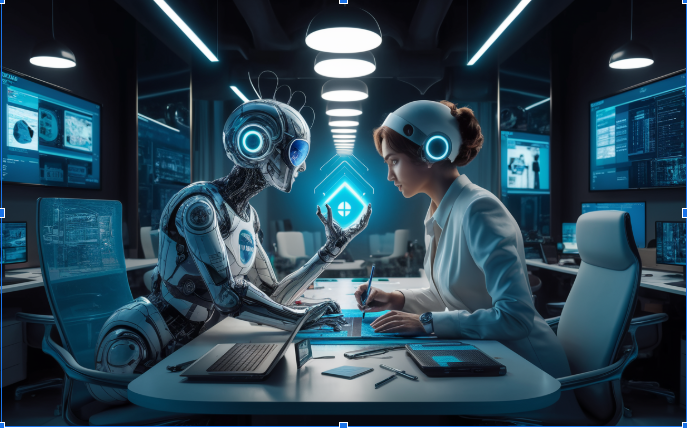
The Rise of Intelligent Enterprise App Development
In the fast-paced digital age, companies are increasingly required to be innovative to streamline workflows and adapt to ever-changing business requirements. Traditional development techniques, though efficient, are often incapable of providing the speed and flexibility that companies require today. That’s where Power Apps, Microsoft’s low-code platform, has revolutionized the industry.
In the quest for smarter, faster, quicker, and more economical ways of creating applications, the synergy of the human developer and AI-driven agent is becoming increasingly important. Human-agent harmony combines the advantages of both technologies to produce flexible, efficient enterprise-level solutions. This powerful alliance opens the way for increased efficiency, lower costs, and faster deployment times. These are benefits that every cross-platform application business is looking to take advantage of.
Understanding Human-Agent Harmony in Development
Human-agent harmony doesn’t simply mean a buzzword, it’s actually a development idea. It’s the process of collaborating between AI-driven developers and human instruments or agents in order to create the best, most efficient, and tested software. In contrast to replacing human capabilities, AI agents augment them in a way, simplifying programming and automating repetitive work.
For enterprise-level app development the harmony between the human brain and expertise in the domain determine the direction for an application, and AI assures that technical execution can be swift, accurate and effective. The result is the potential for new innovation and speed, helping companies to achieve their objectives faster and more efficiently.
Why Power Apps is a Game-Changer for Enterprises
Power Apps offers a visual easy-to-use environment with no code that makes it easier to create apps. It seamlessly integrates with Microsoft’s ecosystem of services, such as Azure, Dynamics 365, and Microsoft 365 offering companies with secure, powerful and adaptable solutions.
Drag-and-drop capabilities and built-in templates let designers and non-developers alike to develop advanced applications in a short amount of time. If combined with AI, Power Apps enables companies to streamline processes, use intelligence-driven analytics, and tailor the user experience, which makes it the ideal tool for a business that develops apps across platforms.
Power Apps + AI – The Perfect Harmony
Power Apps’ AI Builder provides powerful AI in the app. It doesn’t matter if it’s from processing the detection of objects, or even sentiment assessment, AI Builder allows developers to integrate cognitive-based services directly in their apps without the need to write complicated codes.
The integration is able to allow AI agents to take on data-intensive tasks, detect patterns, and recommend improvements, allowing human designers to concentrate on designing, thinking the user experience and strategic decisions. Together, they make the foundation of a powerful team, which reduces the time to market and improves app quality.
Key Benefits of Human-Agent Collaboration in Power Apps
The advantages of using AI agents into Power Apps development are multifold. Most important is speed. AI can handle jobs like form creation as well as error-checking and mapping data at lightning-fast speed. It allows developers to introduce the latest features and updates often.
Second, AI enhances decision-making by studying user information and application performance in real-time. Developers can receive advice as well as insights that help them continuously improve their apps. What does this mean? Improved performance, greater customer satisfaction, and a higher ROI for companies.
1. Accelerated Application Development
- Natural Language Input: Humans are able to describe their requirements as AI agents can generate formulas, logic, or UI elements in a matter of seconds.
- Low-Code Empowerment Anyone can develop complex apps with the help of AI and reduced dependence on IT.
- Rapid Prototyping Teams can iterate more quickly because AI recommends designs, connectors, or parts in real-time.
2. Smarter Decision-Making
- Data Insights Available On Demand AI agents uncover patterns and then generate summaries of the data that is stored in Dataverse or from other sources.
- Predictive Analytics AI-based models aid in predicting outcomes (like the churn of customers or malfunctioning equipment), which allows for proactive decision-making.
- Recommendations in Real-Time: Agents suggest next options for automation or steps based on patterns of use and information.
3. Advanced User Support
- Chatbots integrated: Power Virtual Agents (PVA) are able to assist users in apps by providing answers to questions or helping users navigate the workflow.
- Continuous Learning Bots grow in time, based on feedback received from human interactions. This makes them more efficient and contextually aware.
- 24/7 availability: Agents provide assistance 24/7, helping to cut down the number of support issues.
4. Intelligent Automation
- Process Optimization Agents detect repetitive jobs and suggest automation using Power Automate.
- Error Reduction AI detects any logic error or inefficiency and reduces human errors.
- Seamless Integration Agents assist in setting up connectors, triggers, and flows much more quickly than manual configurations.
5. Better Collaboration & Productivity
- Co-Authoring Capabilities Humans and AI agents may co-author models, dashboards, forms, and even logic in real time.
- Skills augmentation agents serve as an aid system, aiding users in tasks that are beyond their capabilities.
- Speedier onboarding The first-time users are able to master Power Apps quickly with AI-guided help.
6. Better Governance and Compliance
- Guidelines for Policy Enforcement AI flags infractions of the data governance and security policy during application creation.
- Built-in Security Checks AI is able to identify potential security vulnerabilities or inefficiencies within app workflows.
- Audit-Ready Human-agent collaboration guarantees that every process can be recorded and checked for conformity.
7. Scalability across teams
- Reusable Components AI provides models and components that could be used across different departments.
- Consistent Standards: Agents help enforce best practices for app design and data usage.
- The process of democratizing innovation Empowering more employees with AI assistance results in the development of more innovative solutions across the entire organization.
Real-World Use Cases
Think about a healthcare provider making use of Power Apps to create a patient management system for managing patients. Utilizing AI-powered functions such as automated appointments and predictive analytics scheduling, healthcare providers will be able to improve the quality of care while reducing administrative burdens.
Manufacturing companies are able to design maintenance apps using machine learning techniques to identify breakdowns in equipment. This reduces downtime but also increases operational efficiency. These cases demonstrate the potential of the human-agent partnership in workplace environments.
Challenges and How to Overcome Them
Although it has many benefits, the human-agent harmony of the development of apps isn’t without its difficulties. Reluctance to change, skills gaps and privacy issues are all common obstacles. However, they can be tackled through strategic planning and the right education.
In order to build trust in AI, organisations should be able to involve people in the process of developing AI and be transparent about the way AI decision-making is made. Training programs to improve your skills will ensure that IT and business professionals have the confidence to collaborate with AI instruments such as Power Apps.
Role of a Cross-Platform App Development
Collaboration with a cross-platform application development company can greatly make it easier to transition to AI-powered app development. The companies they partner with bring experience in technology as well as design thinking and methods for implementation that speed up technological change.
Utilizing Power Apps in combination with AI and cross-platform apps, an application developer can offer custom solutions that are in line with the company’s goals, while providing cross-device compatibility as well as seamless integration with current platforms.
Future Outlook
As AI technology improves, it is possible to expect greater integration between human programmers and AI agents. Natural machine learning, predictive modeling, and tools for collaboration in real time are expected to continue to improve while reducing the barriers to development.
The future is self-improvement software that can not only automate processes but also take advantage of user behavior to enhance efficiency as time passes. Companies that embrace harmonious human-agent interactions today will be in a good position to be leaders in this smart technological future that is adaptive and adaptable.

